Name
Latin name
Plodia interpunctella
Key features
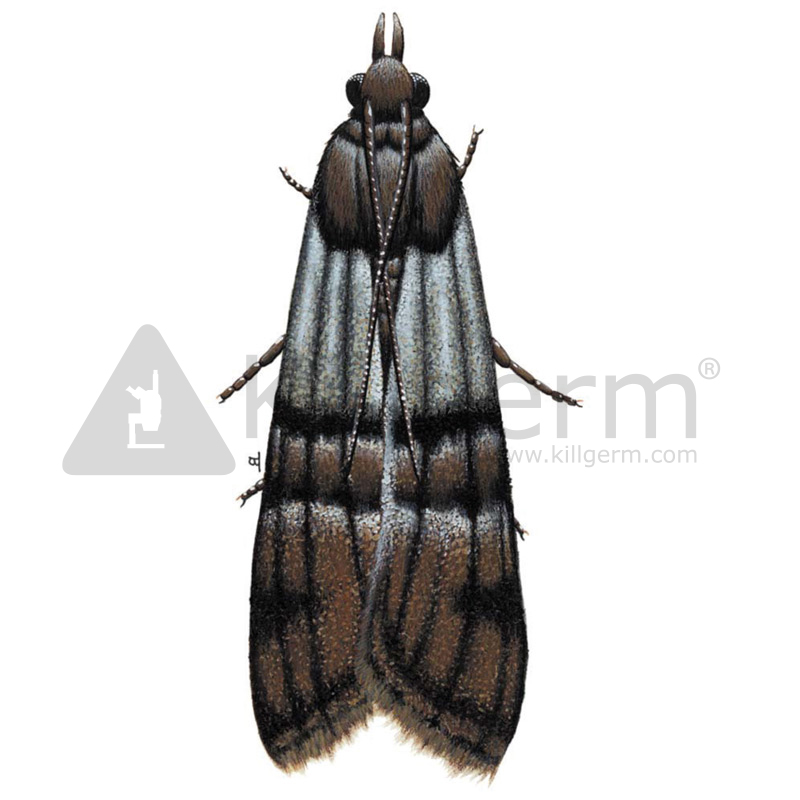
The adult moth has an open wing span of approximately 16 mm.
The forewing has a broad grey band across the bronze brown wings.
In common with other moth species, wing scales are readily lost and wing pattern is therefore an unreliable characteristic for identification.
Positive identification requires the study of adult characters such as wing venation, head appendages and abdominal structures for which a stereoscopic microscope is necessary.
Biology
The female lays on average 150-200 eggs but may produce up to 500.
In common with other insects, development times are influenced by temperature, relative humidity, moisture content, quantity and quality of food. The following figures are therefore only a guide.
Number of days spent as:
Egg: 2 – 8
Larva: 13 – 288
Adult: 7 – 43
Development proceeds at 18 to 35°C and can be completed in 4 to 18 weeks depending on conditions. The number of larval instars varies from 5 to 7. Larvae produce silk webbing as they feed. When a larva is fully developed it migrates from a foodstuff into cracks and crevices, where it produces a cocoon.
When larvae are about to pupate, they may be found at a considerable distance from the foodstuff and typically crawl up vertical surfaces.
Diapause, a resting phase, may be induced by short photoperiods, low temperature or high population pressure. In such circumstances developmental stages are greatly extended. A diapausing larva is extremely resistant to adverse conditions.
Distribution
Plodia interpunctella is a native of the Old World but is now found in practically all parts of the world. It is established in the UK and is also a frequent import on commodities.
Significance
These moths are a common stored product insect attacking cereal products, oil seeds, cocoa beans, dried fruit and nuts. They may also be found on dried vegetables, confectionery etc. It is considered to be the most important moth pest of dried fruit. Rice is frequently attacked.
Control
Treatment consists of finding the sources of the infestation.
Any infested commodities should be isolated and destroyed, the area thoroughly cleaned and then a residual insecticide applied.
The use of an ultra low volume insecticide applicator may also be indicated.
The adult males of P. interpunctella are attracted to the pheromone lures in stored product moth traps. Traps should be utilised to determine the extent of infestation and the efficacy of any control measures.