Name
Latin name
Ephestia elutella
Key features
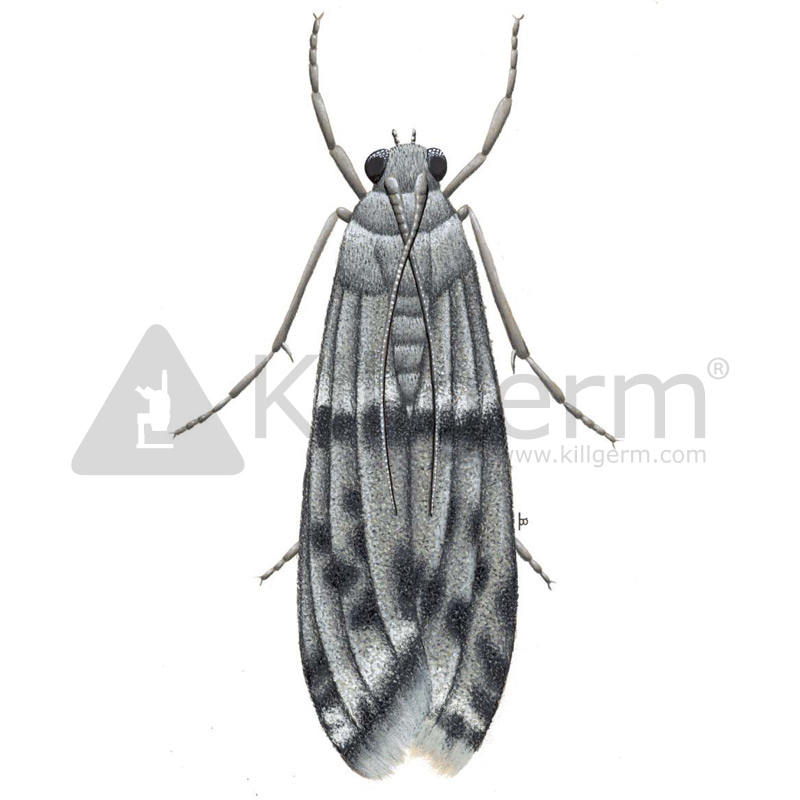
The adult is a greyish moth with a pattern of two obscure bands across the forewings. It has a wing span of 12 to 18 mm.
In common with other moth species, wing scales are readily lost and wing pattern is therefore an unreliable characteristic for identification.
Positive identification requires the study of adult characters such as wing venation, head appendages and abdominal structures for which a stereoscopic microscope is necessary.
The mature larva is 10 – 15 mm long and is creamy white with a brown head capsule and brown body markings. There are three pairs of jointed thoracic legs and five pairs of abdominal prolegs.
Biology
Development proceeds at temperatures of 10˚C and above. Under optimum conditions (25˚C and 70% relative humidity), the life cycle may be completed in 40 days. The minimum relative humidity requirement is 30%. A female produces on average 200 eggs. Diapause may greatly extend the life cycle.
In common with other insects, development times are influenced by temperature, relative humidity, moisture content, quantity and quality of food. The following figures are therefore only a guide.
Number of days spent as:
Egg: 10 – 14
Larva: 20 – 200
Pupa: 10 – 28
Adult: 9 – 21
Distribution
Cosmopolitan.
Significance
This moth is one of the most important warehouse pests in the UK. Whole grains, cereal products, oil seeds, pulses, cocoa beans, dried fruits and vegetables, nuts, tobacco and chocolate may be attacked.
The larva contaminates and spoils food with excreta, frass and webbing.
The adult does not feed on solid food, and tends to fly at dawn and dusk.
Control
Treatment consists of finding the sources of the infestation.
Any infested commodities should be isolated and destroyed, the area thoroughly cleaned and then a residual insecticide applied.
The use of an ultra-low volume insecticide applicator may also be indicated.
The adult males of E. elutella are attracted to the pheromone lures in stored product moth traps. Traps should be utilised to determine the extent of infestation and the efficacy of any control measures.