Name
Latin name
Endrosis sarcitrella
Key features
Open wing span 10 – 23 mm.
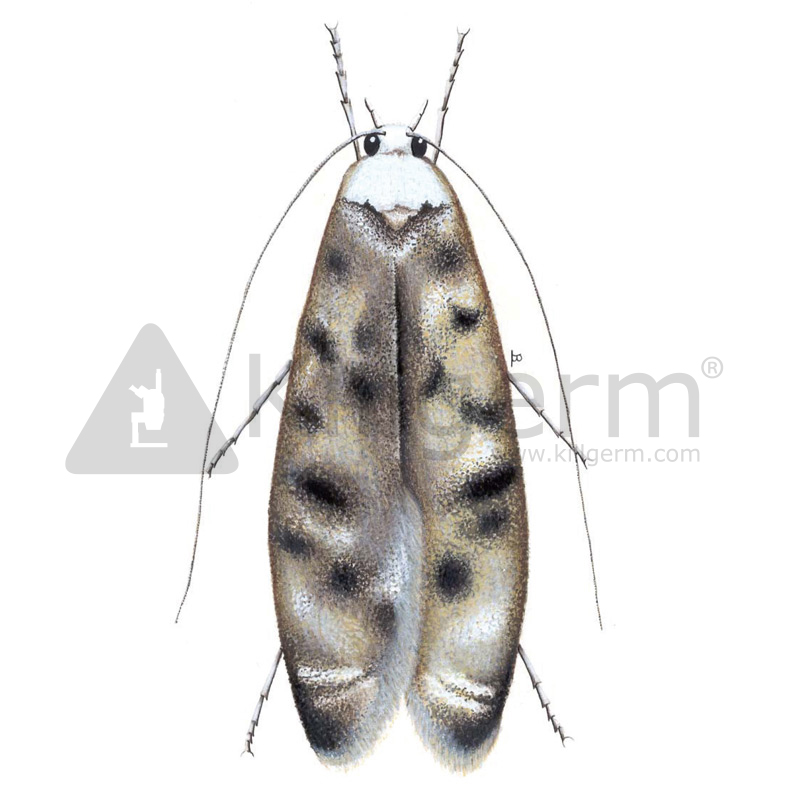
Readily distinguished from other stored product moths by the covering of white scales on the head and thorax.
The shining buff upper side of the forewing is speckled with dark brown.
In common with other moth species, wing scales are readily lost and wing pattern is therefore an unreliable characteristic for identification.
Positive identification requires the study of adult characters such as wing venation, head appendages and abdominal structures for which a stereoscopic microscope is necessary.
Biology
The female lays anything from 14 to 230 eggs.
Larvae require a relative humidity of 80% to develop. Development continues throughout the winter in sheltered situations. No diapausing (resting) stages have been found. Larvae burrow into the foodstuff, emerging when about to pupate.
In common with other insects, development times are influenced by temperature, relative humidity, moisture content, quantity and quality of food. The following figures are therefore only a guide.
Number of days spent as:
Egg: 6 – 23
Larva: 38 – 102
Pupa: 7 – 31
Adult male: 2 – 4
Adult female: 3 – 9
Distribution
This moth is found worldwide.
Significance
This moth is a scavenger and will attack a wide variety of foodstuffs; its presence generally indicates that there are undisturbed residues available, e.g. mouldy commodities or long-standing vegetable debris. It rarely attacks clean foodstuffs.
It has been recorded on seeds, birds’ nests, roof thatches and corks.
Control
Treatment consists of finding the sources of the infestation. The roof space should be checked.
Any infested commodities should be isolated and destroyed, the area thoroughly cleaned and then a residual insecticide applied.
The use of an ultra-low volume insecticide applicator may also be indicated.
This moth is an indicator of less than adequate standards of hygiene.