Name
Latin name
Tineola bisselliella
Key features
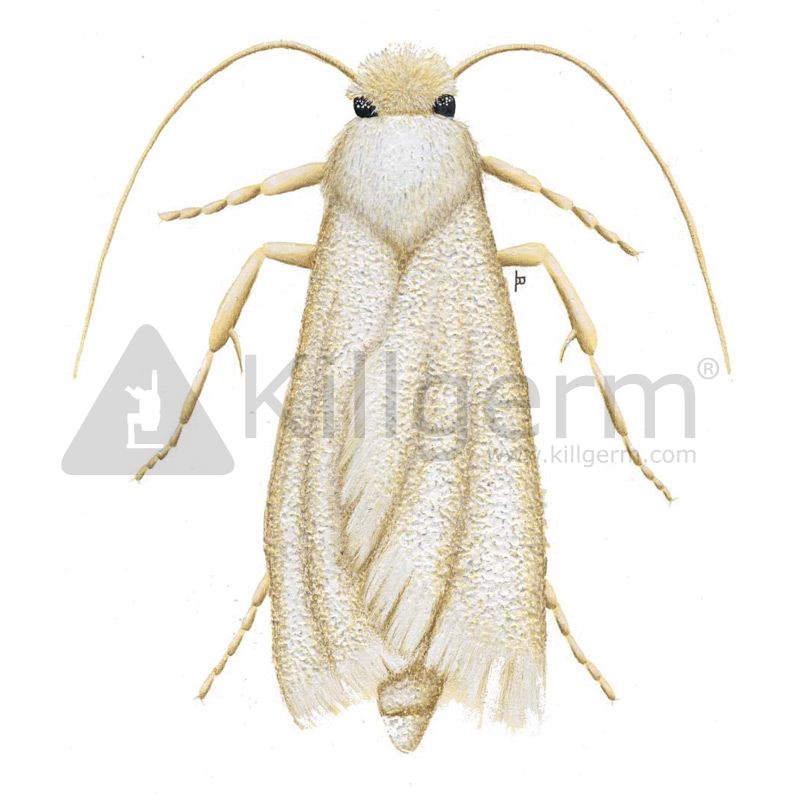
The adult moth has a body length of between 6 and 8 mm and a wingspan of 9 to 16 mm.
The upper side of the fore wings is buff, nearly golden, in colour. Both pairs of wings have fringed margins.
Adults are rarely seen in flight, mostly only the males, and the females after they have deposited their eggs.
The larva is yellowish white in colour with a brown head and measures around 10 mm in length when fully mature.
Biology
The adult female lays eggs, (between 50 and 100), amongst the material upon which the larvae will feed.
The larva emerges from the egg and proceeds to feed. Whilst feeding, the larva of the clothes moth frequently constructs a loose silken “shelter” which has attached to it many particles of debris
and faecal pellets etc. Once mature, the larva pupates.
The pupa is reddish brown in colour. There is a certain amount of mobility in the abdomen of the pupa and it twitches if disturbed.
The adult emerges from the pupal case. The adult moth lives for around 2 – 3 weeks.
In common with other insects, development times are influenced by temperature, relative humidity, moisture content, quantity and quality of food. Total life cycle at 23.5˚C and 50% relative humidity is takes 63 days.
Distribution
Worldwide.
Significance
The clothes moth is a significant pest, the larvae feeding on a wide variety of material of animal origin such as woollens, furs, etc. Damage from larval feeding can be severe and the larvae are often difficult to detect since they shun the light.
Outdoors, adults are on the wing from May to September. Indoors, adults are found all year round.
Control
Treatment consists of tracing the source of infestation, removing and destroying any infested foodstuffs and then applying a residual insecticide to infested areas.
Care should be taken to select a non-staining insecticide if soft furnishings are to be treated.
Additionally, an ultra-low volume application of insecticide would prove effective.
The use of monitoring traps specific for this species will aid in determining the level of infestation.
Whilst there is no difficulty in controlling these moths, it is essential that a thorough treatment be carried out and that every possible larval development site is treated.
They may be found in association with birds’ and mammals’ nests, therefore these possibilities should be checked when tracing the source of the infestation.