Name
Latin name
Tinea pellionella
Key features
The adult moth has a body length of between 3.5 and 4 mm and a wingspan of 10 to 15 mm.
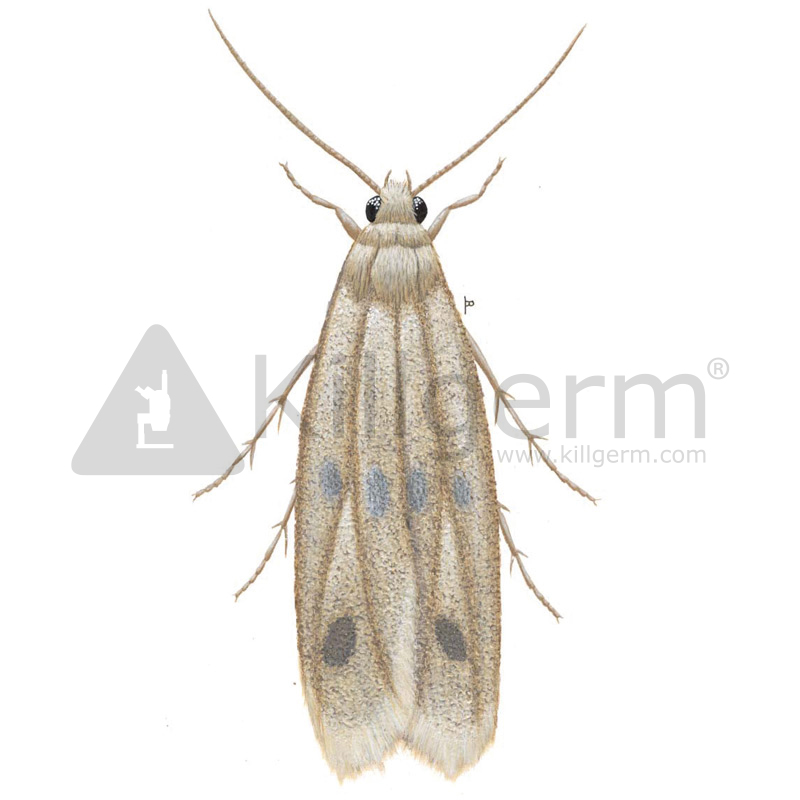
The upper side of the fore wings is pale brown in colour with three darker spots on the wings, but these are often difficult to see. Both pairs of wings have fringed margins.
The general appearance is very similar to that of the clothes moth, Tineola bisselliella.
The larva is easily identified as it has the habit of carrying a silken tube that gives the moth its common name. The larva constructs the tube of silk and often attached to it are particles of wool, fibres, etc from the immediate habitat. The case is open at both ends and the larva is rarely found outside it.
Biology
The adult female lays eggs and attaches them to the substrate with a glue-like substance. The eggs are distinctive in their appearance having clear longitudinal ridges.
The larva emerges from the egg, constructs its silken case and proceeds to feed. Once mature the larva seals both ends of the case with silk and pupates within the case.
The adult emerges from the pupal case. The adult moth lives for around 2 to 3 weeks.
In common with other insects, development times are influenced by temperature, relative humidity, moisture content, quantity and quality of food.
Distribution
Wide distribution in Holarctic Region and Australia. The Holarctic region covers the whole of Europe (as far as the North Pole), Northern Africa, Asia Minor and the Middle East, the northern part of the Arabian peninsula, Soviet Asia, China, Korea, Japan, North America and the adjacent islands to the north, including Greenland, and extends in the south to central Mexico.
Significance
The case-bearing clothes moth is a serious pest when it is encountered feeding on a wide variety of material of animal origin such as woollens, furs, etc.
Damage from larval feeding can be severe and the larvae are often difficult to detect. Typically damage occurs to “neglected” areas such as carpets under heavy furniture.
Control
All carpeted areas and soft furnishings should be treated.
As these insects may be associated with birds’ nests, the roof space should be examined and treated if necessary.
A non-staining insecticide is recommended.