Name
Latin name
Anthrenus museorum
Key features
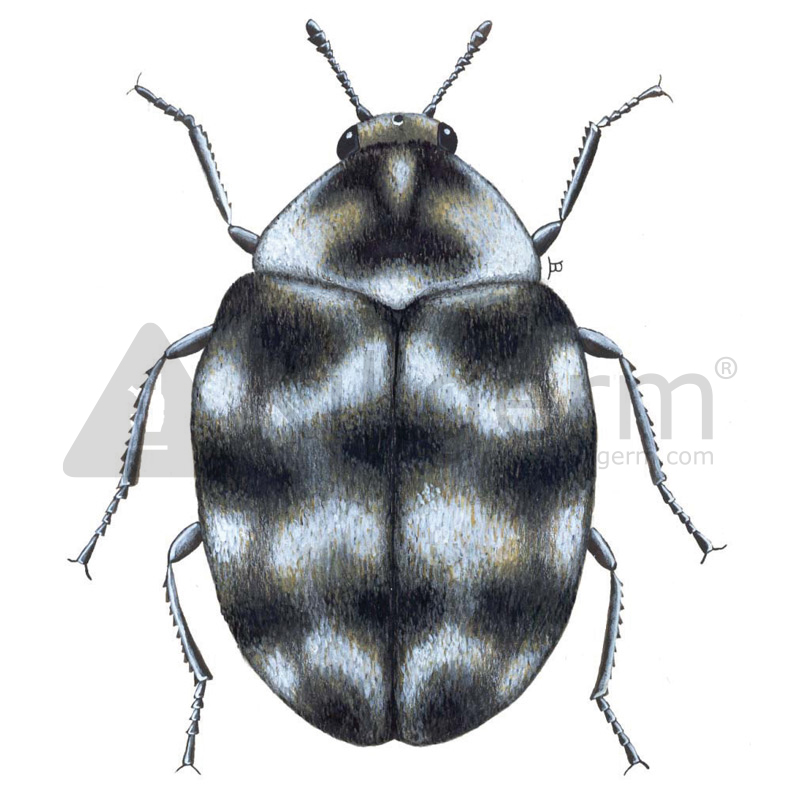
The adult beetles, which are around 3 mm in length, have a speckled appearance which arises because of the many scales which cover the elytra and the prothorax. These scales are black, white and yellow in colour and they give the beetle a spotted appearance. As the beetles age these scales are often partially or totally rubbed off and the beetles then take on an even more mottled appearance.
The antennae have eight distinct segments with a two-segmented club.
The larvae of Anthrenus have a characteristic appearance, being covered in well developed hairs arranged in many tufts positioned at the intersegmental folds, giving rise to the common name for these larvae, “woolly bears”. The hairs, when inspected closely, can be seen to be segmented and have a sharp arrow-like head at the end.
The larvae grow from around 1 mm when they first emerge from the egg to around 5 mm when fully grown.
Biology
The female beetles lay around 100 eggs in batches within the larval foodstuff. The eggs are small (0.2 – 0.5 mm long), white and are frequently “stuck” by a secretion from the female accessory glands to the fabric of the material in which they have been deposited.
The larvae emerge from the eggs and start feeding. The larvae are repelled by the light and as a result burrow deeply into their food. As they grow they moult and the cast skins are frequently found amongst the feeding larvae and this often gives the impression of a larger population than is, in fact, present.
Larval life is greatly dependent upon the quality of the food upon which it is feeding.
Once fully grown the larvae pupate within the last larval skin and from the pupa emerges the adult.
There is often a gap between the development of the adult in the larval skin and the emergence of the adult, this can often extend to a month.
In common with other insects, development times are influenced by temperature, relative humidity, moisture content, quantity and quality of food.
Egg to adult at 18˚C is around 10 to 12 months.
Distribution
Worldwide, however it is far less common than Anthrenus verbasci.
Significance
The larvae can be destructive pests of materials of animal origin and, as their common name suggests, they are extremely serious pests of zoological specimens in museums.
Damage can also occur to furniture where there are fabrics and materials of animal origin used in their construction.
It is rarely found as a pest.
In common with other insects bearing hairs, skin contact with the larvae may cause irritation.
Control
Treatment consists of identifying the extent of infestation and then treatment of affected areas with a residual insecticide.
Checks should be made to ensure that old bird nesting material or similar is not harbouring infestation.
If carpets are to be treated then an insecticide which will not stain or otherwise damage the carpet should be selected.